
Knowledge management software captures an organisation’s knowledge, processes and workflows in a structured form, makes them accessible and keeps them current. What separates it from a filing system: it links information to roles, responsibilities and process steps — so knowledge isn’t merely stored, it’s usable.
Documenting workflows strikes many people as bureaucracy. In practice it’s the precondition for a team functioning beyond the individuals in it.
The real problem: same role, two different ways of working
Most teams have this situation: two people in the same role complete the same task in completely different ways.
One follows a checklist that emerged over years of trial and error. The other learned the craft by watching a colleague for weeks and filling in the gaps themselves.
Both deliver results. But the approach, the quality and the time taken differ more than anyone wants to admit. And nobody can say which version is the better one — because neither is written down.

This isn’t an employee problem. It arises when documenting workflows was never made binding: processes exist, but they’re invisible, scattered and applied inconsistently. Knowledge silos don’t come from bad intent, they come from missing structure.
As long as everyone involved is present and volumes stay steady, it works. It stops working the moment anything changes.
The gap between “we have a process” and “we have a documented process”
Most team and department leads hold a clear mental map of their workflows: what happens first, who takes over next, what has to be checked. That map exists in exactly one place — in someone’s head.
The gaps appear the moment it has to be passed on. A new team member starts. A project moves to another department. A client asks how something is delivered. Suddenly the informal understanding that held everything together isn’t enough. Documentation gets written in a hurry — or an experienced colleague spends hours explaining what should have been captured long ago.
The difference isn’t whether you have a process. It’s whether that process is structured, accessible and maintained over time.
What separates knowledge management software from a wiki
An internal wiki collects knowledge. Knowledge management software makes it operational. The difference is in the linkage:
| Internal wiki | Knowledge management software | |
|---|---|---|
| Content | Pages and articles | Structured workflows broken into steps |
| Ownership | Usually not captured | Each step is assigned to a role |
| Competence link | None | Requirements per step are visible |
| Findability | Full-text search | Searchable by process, role and step |
| Use | You read it | You work from it |
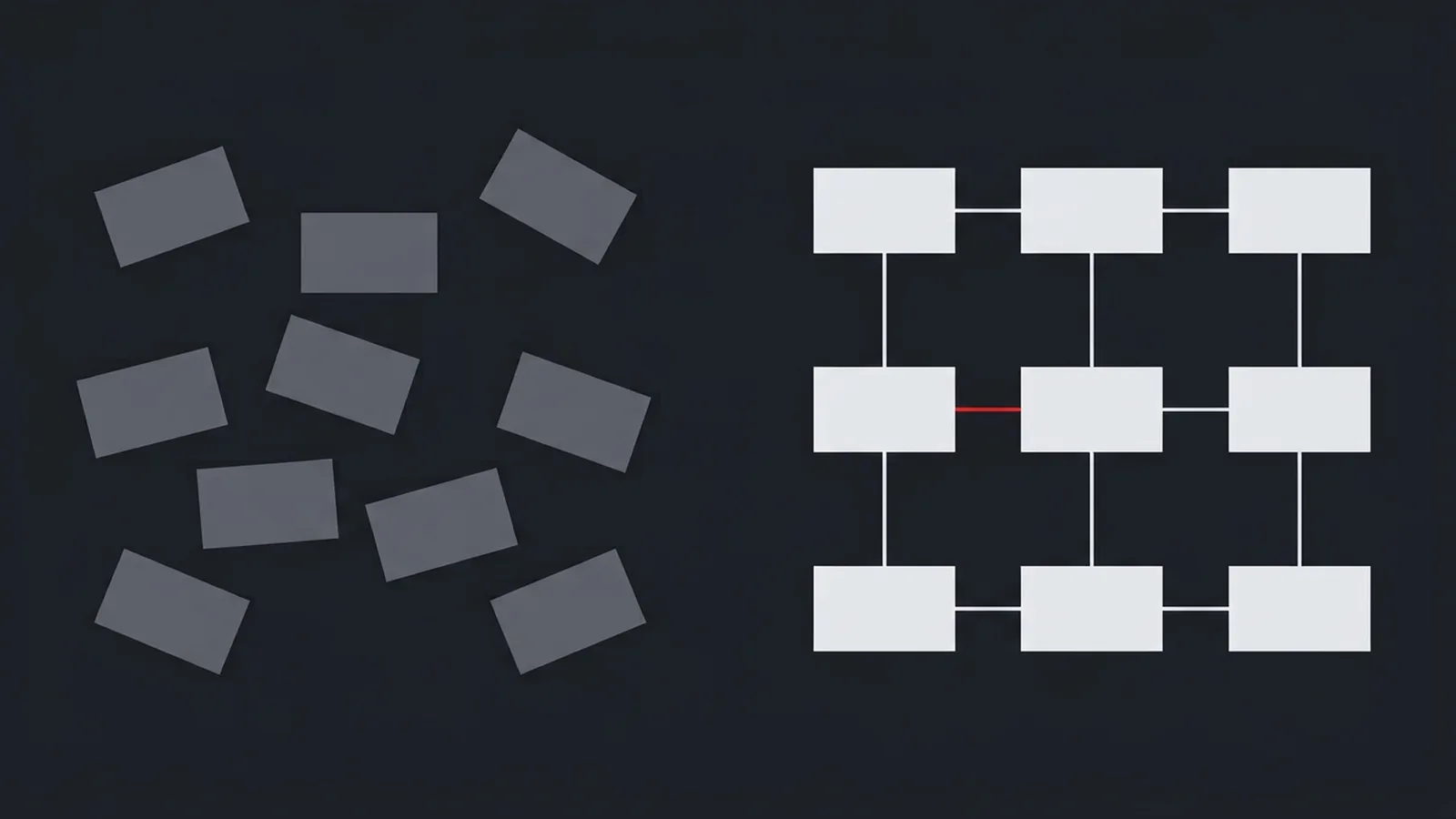
In Kollegia, each workflow is broken into the steps needed to complete it: what happens in this phase, which tools are used, how long the step typically takes, and how you know it’s done. Where a step requires a specific competence, that requirement becomes visible — and with it, where the team has capacity and where a gap is forming before it turns into an obstacle.
Where the difference shows most
In onboarding
When a new person can follow a documented workflow instead of assembling the knowledge from several colleagues, time to productivity shortens. More importantly, the process stops varying according to who explains it.
In handovers and staffing decisions
When workflows are documented and linked to roles, it becomes visible who can take on which task and where competence has to be built. Decisions previously made on intuition get a basis. The skills matrix supplies the underlying data.
In audits and client conversations
When a client or auditor asks how something is delivered, the conversation shifts from reconstruction to demonstration. You show a structured workflow rather than assembling one on the spot.
When someone leaves, the documented procedure stays in the system. Which tasks structurally depend on single individuals is what Skill Audit makes visible; what to do during a temporary absence is covered in our article on absence cover.
Why documentation still doesn’t get written
The most common reason isn’t resistance, it’s effort. Whoever is asked to document a process faces a blank page knowing the work will cost an hour nobody has today. So it gets postponed — permanently.
That’s why digital colleagues take on part of this work in Kollegia. Lena, one of Kollegia’s Digital Colleagues, turns a few bullet points into a complete step description, so documenting costs minutes rather than hours, and flags processes with no responsible role assigned. Why documentation also has to be maintained after it’s written is covered in our article on process documentation.
Three principles
- Permission intersection — a digital colleague never sees more than the person it works for.
- Fail-closed — when in doubt, nothing happens. If it’s unclear whether a change is correct, it’s submitted for review rather than applied automatically.
- Audit trail — every change is logged: when, by whom, on what basis.
FAQ
Source: ISO 9001:2015 – Quality management systems, Requirements, ISO.
Knowledge management software captures an organisation’s knowledge, processes and workflows in structured form, makes them accessible and keeps them current. Unlike a conventional filing system, it links information to roles, responsibilities and process steps — so knowledge stays usable even when individuals leave the team.
A wiki collects knowledge; knowledge management software operationalises it. In a wiki you find information; in a knowledge management solution the same information is linked to roles, process steps and competence requirements. That makes the knowledge not just retrievable but directly applicable.
Division of labour matters more than size. As soon as two people can take on the same task and the result depends on which one does it, the need exists. In growing teams there’s a second factor: otherwise every new hire has to receive the knowledge verbally all over again.
The workflows where execution currently depends most on the individual — that’s where the variance is largest. After that, the processes that run most frequently, because that’s where the investment pays back fastest.